

Morocco is consistently ranked as the best African team in the World Cup, holding the top spot in the continental FIFA rankings and making history as the first African team to reach a World Cup semi-final in 2022.
Under head coach Walid Regragui, Morocco did not concede a single goal until the semi-final against France, keeping clean sheets against Croatia, Belgium, Spain, and Portugal.
Morocco finished first in Group F with seven points after wins against Belgium, Canada and the draw against Croatia. In the round of 16, Morocco defeated Spain 3-0 on penalties after a 0-0 draw in regular and normal time.
In the quarter-finals, the Atlas Lions defeated Portugal 1-0 via Youssef En-Nesyri, making history as the first African and Arab nation to reach a World Cup semi-final.
However, their journey ended in the semis after losing 2-0 against France. In the third-place playoff, Morocco lost 2-1 against Croatia to secure fourth place overall.
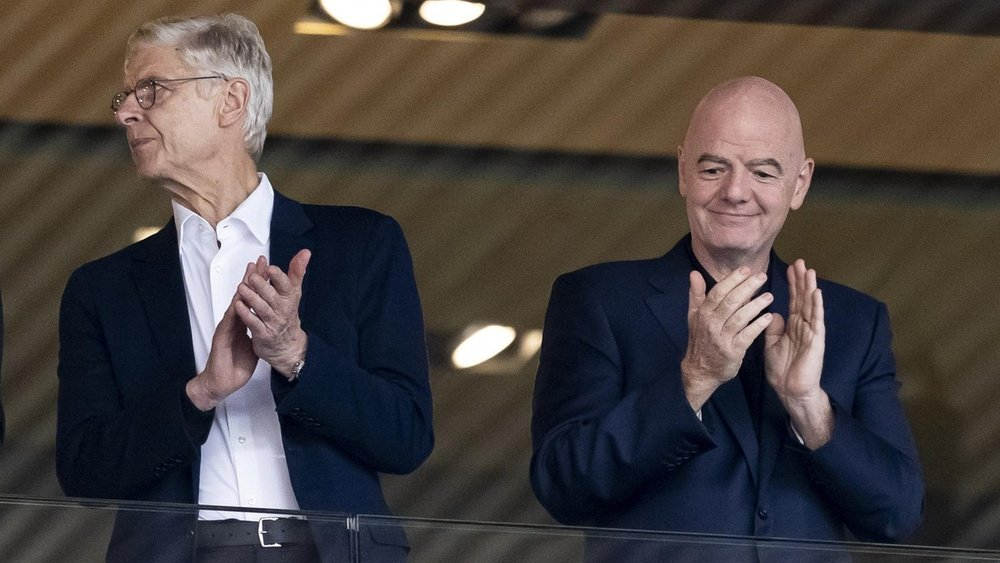
According to Wenger, who currently serves as the FIFA Chief of Global Football Development, Africa is close to breaking the duck and winning the World Cup.
The Frenchman singled out Africa’s improvement at the 2026 FIFA World Cup on tactical discipline and organisation, saying it was one of the biggest reasons nine African teams advanced from their groups.
‘The numbers don’t lie’
“Africa has made a fantastic step forward. There is still another step to make. We want to see an African team win the World Cup, and the numbers show that it is feasible,” said Wenger during the CAF Strategy Conference in Santa Maria, Sal Island, Cape Verde, as quoted by CAFOnline.com.
“The numbers don’t lie, but football is not only numbers. It is also attitude, mental qualities, unity and your value system. Those are things you have to continue working on.”
During the World Cup in the USA, Canada, and Mexico, nine African (CAF) nations qualified for the Round of 32 at the out of 10 representatives (with Tunisia being the sole group-stage elimination).
“In the past, African teams sometimes lost because of a lack of compactness, too much distance between the lines and inconsistent concentration,” offered Wenger.
“At this World Cup, it was difficult to beat any African team because the discipline and organisation were at the top level.”
Wenger added: “We are very close, but a small percentage can cost you the game. Most of these games were lost by one goal, so every detail in the modern game becomes absolutely vital.”
‘Morocco a role model’
Former Ghana coach Otto Addo, who worked with FIFA’s Technical Study Group throughout the World Cup, echoed Wenger’s sentiments while singling out Morocco for showing that it was possible.
“Most African teams have the potential and the physicality to press higher, to be brave and to win the ball higher. Morocco showed that it is possible,” said Addo.
“Morocco are a role model in that respect. It was impressive to see how they could dominate teams like Brazil, and I see other African teams with the same possibilities.
“Sometimes you make 10 runs, and you don’t get the ball, but perhaps the 11th time you do. You need those profiles – players who keep getting into the box.”
Cape Verde coach Pedro Brito, more commonly known as ‘Bubista’, said: “We prepared the group over a long period, and the discipline within the team gave us the capacity to reach the World Cup.
“From the beginning, we defined our objective: we wanted to move into the knockout stages. I told our leadership, ‘I don’t know how, but we are going to the knockout stage’.
“Something that is sometimes lacking in African football is clearly defined objectives for these competitions. Very few teams say clearly: ‘We are going to reach the final’ or ‘we are going to reach the semi-finals’.”
Cape Verde made history during their debut at the 2026 FIFA World Cup, advancing out of the group stage as the smallest nation ever to reach the Round of 32.