

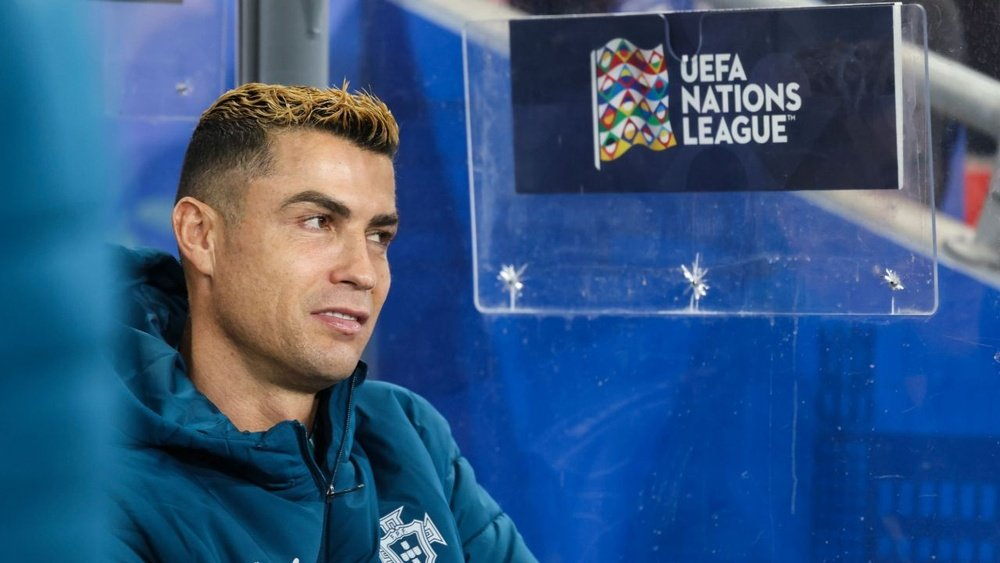
Cristiano Ronaldo has issued an explosive statement explaining his departure from the Portugal squad, accusing manager Jorge Jesus of deceit and avoiding the media.
“As promised, I have decided to recount directly and firsthand the circumstances surrounding the final chapter of my time with the national team.
Following the 2026 World Cup, I drafted a letter addressed to the Portuguese people, which I still have in my possession, expressing what I wished to convey whenever I stepped away definitively from our side.
At the conclusion of the tournament, on the flight back from the United States, the Federation President pleaded with me to reconsider walking away, insisting that the FPF wanted me to stay.
Shortly afterwards, he asked for my thoughts on the current manager, whom he was considering alongside other undisclosed candidates.
I told the Federation President that, in my view, hiring him would be the right decision.
Consequently, on the day the manager was officially presented, I was genuinely thrilled with the choice. It was the right call, as results have proven.
A few days later, I received my first phone call from the new national team boss, who asked to meet in person. I agreed, and we arranged to sit down at the end of my holidays.
We met at the Cidade do Futebol, where my club were holding their pre-season preparations.
During that meeting, the coach assured me that he was counting on me and that my involvement was pivotal to his project. Right there and then, he outlined a plan for my participation. He explained that I would feature in the first and final matches, and that to manage physical demands, he would routinely make three to four substitutions per fixture.
He also suggested at the time that I should not travel with the squad to Norway and Denmark. His proposal was for me to play the opening match, remain in Portugal, and link back up with the team ahead of the game in Porto.
I turned that offer down on the spot. It was immediately obvious to me that I could never accept such terms. Sitting out away fixtures did not mean I stopped captaining this side. Receiving the privilege of staying behind in Portugal would have set a dreadful precedent.
In the end, the manager accepted my stance.
Present at that discussion was Simao Coutinho, sporting director at Al Nassr, to whom the manager had reported throughout the previous campaign and who had played a central role in bringing him to the club in 2025.
On the eve of the training camp, the manager requested to visit my home in Lisbon for another discussion. It was a calm exchange, and every principle agreed in August was upheld.
I took part in the fixture at Alvalade and, despite starting on the bench, I did not cause the slightest friction. I even handed the captain’s armband to Bruno Fernandes, never anticipating that these could be my final moments representing and captaining my country. The only thing that mattered to me that day was securing the win. Winning is always special, but winning in Portugal for my nation is unmatched.
At lunchtime on the day of the clash in Norway, an assistant coach approached our table to say the manager wanted a word. Much to my surprise, he asked whether I was ready to play 30 minutes. I was entirely focused on my recovery programme, fully integrated with my team-mates as ever, and had assumed I would not feature that day. There was no issue whatsoever.
Although the request fell outside my scheduled recovery and training regime—given I was only slated to play on the 4th at the Dragao—I naturally agreed. He instructed me to stay ready because I would be given 30 minutes.
The rest is history. From half-time onwards, the tension mounted; I watched the clock wind down, and the call never came.
The manager had broken his word.
When the final whistle blew, all I wanted was for the match to end in victory and to be left alone. I did not head over to applaud the fans. It was an error for which I accept full responsibility, and one that should never have occurred. I sincerely apologise to the Portuguese people who backed us with such passion, to the supporters in the ground, and to everyone who travelled to watch me, Portuguese or otherwise, whom I let down.
Forty-eight hours later, another meeting took place between myself, the manager, and Simao Coutinho, who had overseen our initial discussions in August.
It was an intense, raw, and unfiltered conversation.
We concluded there was only one way to resolve the situation: the manager had to state publicly in the press room what he had conceded to me privately in front of Simao Coutinho.
The arrangement was crystal clear: the manager would open his press conference by addressing the matter directly and clearing the air with the truth. He would clarify that I never demanded to play, that he alone drew up the plan for this international window, that sending me to warm up without bringing me on was an error, and that it would not be repeated.
We concluded the meeting with the manager embracing me, promising he would state word-for-word in the press conference what he had told me, and that the chapter was closed. I would sit out Denmark and feature against Porto. All of this was, as always, witnessed by Simao Coutinho.
At the manager’s behest, a video call then took place between him, Simao Coutinho, and Tiago Craveiro, summarising our agreed terms.
A short document was compiled, which I personally cleared, and which I understand was handed to the manager exactly as he had requested.
Yet the press conference unfolded entirely contrary to expectations: his tone bore no resemblance to our private discussion. I heard remarks and an aggressive posture that felt wholly unjustified—a “my way or the highway” rhetoric that was never once mentioned in private the previous day.
The agreed points I had signed off on were as follows:
“I believe it is important, precisely because it is the truth, to clarify a few matters before taking questions on Denmark.”
1. I personally presented Cristiano, with no third parties involved, a plan for this season with the national team. It was a comprehensive and highly constructive conversation.
2. I recognise his profound passion for the National Team, his global standing, and above all, the immense contribution he has offered to the National Team across 24 consecutive years.
3. Cristiano accepted the plan I put forward.
4. At no point did he challenge my decisions. He remained exemplary, loyal, and utterly professional throughout.
5. The match against Norway was not part of the initial schedule mapped out for him. However, feeling he had physically recovered from the opening fixture, I alerted him that I might call upon him. Cristiano agreed.
6. It was a mistake to send a player of Pele or Maradona’s stature to warm up only to leave him unused. Had it been today, I would not do so.
7. In closing: I want Cristiano in the national team. In truth, I don’t simply want him; I want him immensely. Fortunately, he also retains faith in me. He believed in me at Al Nassr and placed his trust in me here as well.
8. Regarding the failure to applaud the supporters: this has already been addressed. A player with over 230 caps for the national side needs no lectures from me on what it means to love Portugal. It was a fleeting moment of frustration that erases nothing. He signs the most autographs, takes the most selfies, and displays unmatched warmth toward the supporters. We should not manufacture controversies where none exist. When things do not go our way, we react. That is all.
Crucially, none of those points included the manager apologising to me.
It marked the second time he went back on his word.
I chose to leave the training camp rather than wait around for further broken promises. To me, honesty is the supreme virtue in human relations. Even when it stings, I require transparency from people.
Furthermore, during a conversation with the President of the Portuguese Football Federation and the national coach on the morning of that press conference—which both can readily verify—I reiterated that if they no longer wanted me around, they only had to say so. They just had to be direct. I would have accepted it, and I promised we would arrange a fitting, dream farewell with zero animosity.
I recall it vividly: they replied in unison, “No,” insisting that my place remained with the national team.
Never, across a career spanning nearly 25 years, have I interfered with tactical or technical decisions made by any manager. I accept their calls, through thick and thin. I respect their authority, but when someone betrays their own commitments, I feel I no longer belong.
I also owe an apology to my international team-mates for walking out on the camp. Regardless of the absolute breakdown in trust with the manager—which anyone present can corroborate—I should not have departed. The responsibility rests squarely on my shoulders.
I apologise once more to the Portuguese public, but having that trust shattered cut deeply. I realised that from that moment on, my presence would only prove detrimental to the squad, so I did what I always vowed to do if I ever felt useless: I packed my bags and walked away.
The Sao Paulo Football Federation must now assess and rule on the repercussions of my actions. I believe any disciplinary measure should not factor in mitigating circumstances. I am not simply another squad member; I am the captain, which serves as an aggravating factor. I have already offered my apologies, but actions carry consequences. Anyone devoted to football, as I am, understands that rules must apply equally to all, irrespective of stature.
On that note, there has been widespread chatter regarding testimonial matches, the need for a dignified farewell, and the Federation’s desire to provide one.
I learned early in life, often while hungry with nothing on the table, that nothing is ever handed to you for free.
I can assure my supporters, and above all the Portuguese public, that we will stage one or more farewell fixtures; there will be ample time for that.
Yet whenever the national team comes to mind, my immediate instinct is competition. That was my exact mindset the day I received news of my father’s passing. I was in camp with the national team and opted to stay until the following day’s fixture was completed. I did for my country what I would never have done for any club.”
Therefore, provided I am in peak condition, performing for my club, and continuing to find the net, once my sanction is fulfilled, I will remain fully available—just as I have always been—to compete and win with our national team.
That, believe me, is the honest truth.”